
Why Goals Exhaust You — and What to Do Instead
May 08, 2026
A quieter way to move forward, shaped by 2,500 years of Buddhist wisdom.
By Harsha Liyanage, Founder of KindnessCode.org
Why goals can feel exhausting
You set a goal. You work hard. You review — and some things go well. For a moment, it feels good. Then comes that familiar sting: why didn't this one work? You note what went wrong. You adjust. You try again. The loop continues.
Sound familiar? Most of us live inside this cycle. We've been taught that this is simply what ambition looks like — set targets, push harder, review, repeat. And when the loop feels exhausting or hollow, we assume the problem is us. We're not disciplined enough. Not consistent enough. Not resilient enough. But what if the loop itself isn't the problem? What if the problem is something subtler — the invisible force driving you into the loop?
The treadmill nobody talks about
Here's what actually happens inside that cycle. When a goal succeeds, there's a brief hit of satisfaction — then immediately, a new target. When a goal fails, there's frustration, self‑criticism, and pressure to fix it fast. Either way, there is no real rest. No genuine reflection. Just motion. The treadmill keeps moving whether you're winning or losing. And the harder you push, the faster it spins.
The exhaustion isn't from the work. It's from the relationship you have with the outcome. There are really only three responses most of us cycle through when something doesn't go as planned: accept the positives and move on; give up entirely; or grit our teeth and try harder. None of these is wrong, exactly. But none of them asks the deeper question — what was I actually trying to create here, and am I going about it wisely?
The gardener's secret
Consider a gardener. She plants a seed, waters it, tends the soil. She doesn't stand over it demanding it grow faster. She doesn't give up because it hasn't sprouted by Thursday. She understands something fundamental: her job is to create conditions, not to manufacture outcomes.
Think about what it actually takes for one plant to bear fruit — sunlight timing, rainfall, soil temperature, insects for pollination, wind patterns, root depth. None of these is fully in her control. All of them matter. Her wisdom lies not in forcing the fruit, but in learning to read and respond to the whole living system around her.
The Shift: From Forcing Outcomes to Creating Conditions
Most of us approach our goals like engineers managing a machine — precise inputs, predictable outputs, and frustration when the numbers don't add up. But life doesn't work like a machine. It works like a garden. And gardens require a different kind of intelligence.
When we become obsessed with timelines — why isn't this working yet, I've been at this for three months — we've confused the stopwatch for the compass. We're measuring speed when we should be asking: am I pointing in the right direction? Are the conditions right?
The exhausting question vs. the wiser question
The exhausting question: Am I progressing fast enough?
The wiser question: Am I creating the right conditions?
Try this shift in one minute with the free 60-Second Reset (Guided Video).
What truth has to do with it
There's another ingredient the gardener relies on — one we often skip in our rush to move forward: honesty. She looks at the plant as it actually is. Not as she hopes it is. Not through the lens of how much she's already invested. She sees clearly, and responds to what's real.
This is harder than it sounds. When we're stressed, attached to a result, or running low on patience, our perception distorts. We see what we want to see. We react to stories in our heads rather than facts on the ground. And that's when the loop becomes a trap.
The antidote isn't more effort. It's more honesty — with yourself, with the situation, with what's actually working and what isn't. When you ground yourself in what is true rather than what you fear or hope, something remarkable happens: the next right step becomes obvious. Not the perfect step. Not the final step. Just the next honest one.
A five‑step reset you can use today
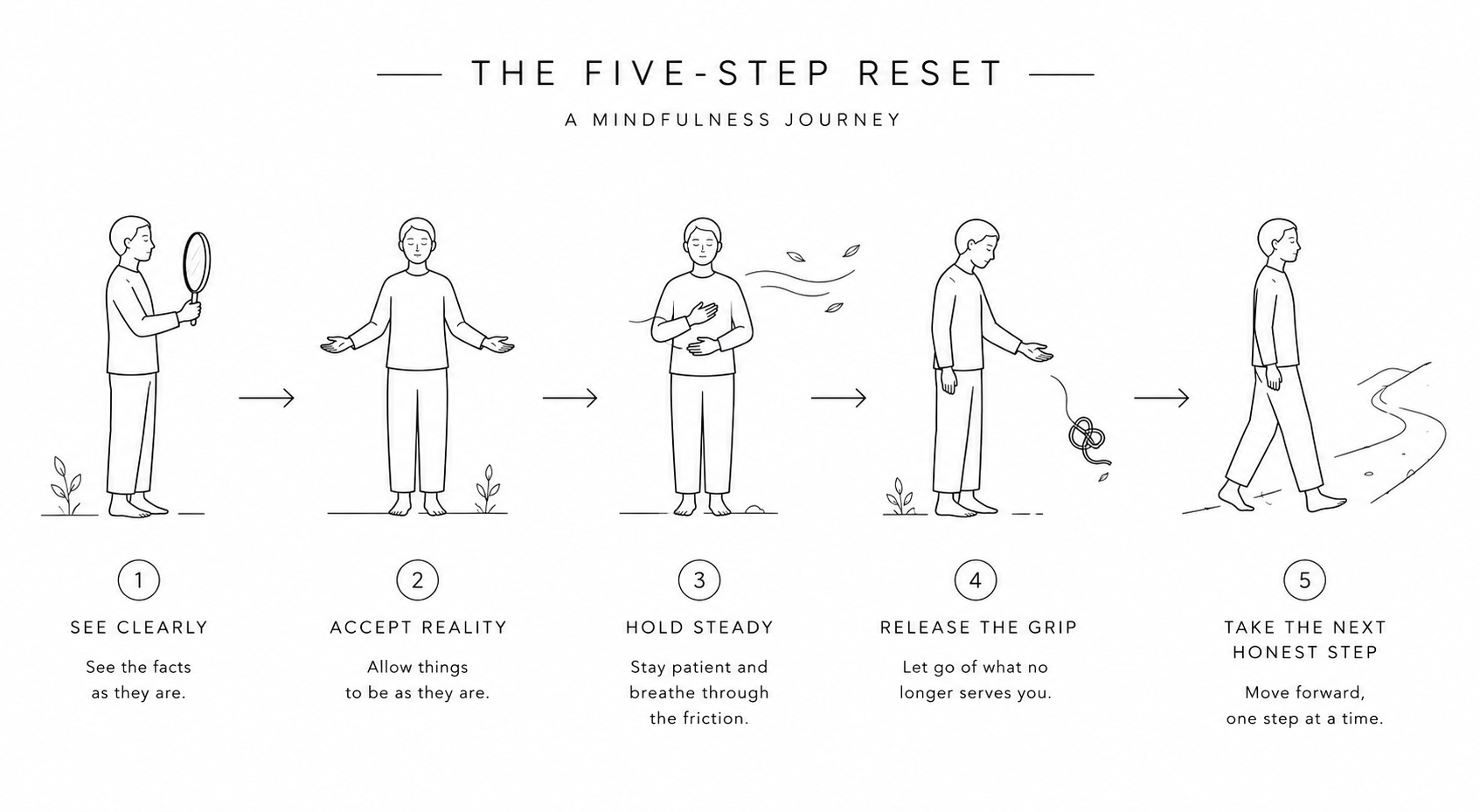
Here is what this looks like in practice — a simple sequence you can run through whenever you feel stuck, overwhelmed, or caught in the loop:
- See clearly — pause and ask: what is actually happening right now? Not the story, not the fear. The fact.
- Accept reality as it is — resist the urge to immediately fix or spin. Let what's true simply be true for a moment.
- Hold steady — don't react from frustration or panic. Take a breath. Friction is information, not failure.
- Release the grip — let go of the specific outcome you're clinging to. Stay committed to the direction; loosen your hold on the destination.
- Take the next honest step — not ten steps. One. Simple, practical, achievable right now.
Repeat this — not as a loop of strain, but as a spiral of gradual refinement. Each time around, a little clearer. A little freer. A little more aligned with what actually matters.
Here's where it gets interesting
If you've followed this far, you might be thinking: this makes sense — but where does it come from? Here's what might surprise you. Every single element of this framework has been mapped, practised, and refined over 2,500 years. What feels like practical modern wisdom is, in fact, the living heart of Buddhist philosophy — specifically, a set of teachings called the Paramitas: qualities of mind that, when cultivated together, transform how we move through any challenge.
The Buddhist wisdom behind the practice
The five Paramitas — and what they actually mean
A note for the curious: Buddhist teaching identifies ten Paramitas in total — a complete map of the qualities that lead to wisdom and liberation. The five below are the ones most directly at work in the story you have just been reading.
- Sathya · Truth: See clearly. Align your actions with reality, not with what you wish were true. This is the compass.
- Upekkha · Equanimity: Accept reality without distortion. Neither inflate the good nor catastrophise the bad.
- Khanti · Patience: Hold steady through difficulty. Friction is part of the process — it is not a sign you are failing.
- Nekkhamma · Renunciation: Release the white‑knuckled grip on specific outcomes. Stay true to your direction without being enslaved by the destination.
- Adhishthana · Resolve: Act. Not frantically, not fearfully — but with quiet, clear, unhurried purpose.
These aren't passive ideals. They're an active operating system for navigating the messiness of real life — careers, relationships, creative work, health, purpose. The gardener already knows them intuitively. The question is whether we can learn to live by them consciously.
The loop doesn't disappear. But it stops being a treadmill and starts being a teacher. You're not trying to escape the cycle of effort and review. You're learning to move through it with wisdom instead of anxiety. Stepping out of the time trap doesn't mean ignoring time. You still act in time. But you are guided by truth and right conditions — not by a stopwatch pressing against your chest. That's not a loop anymore. That's a path.
Start here: The 60‑Second Reset
If any of this resonated, the simplest place to begin is with one minute. Not a course, not a commitment — just sixty seconds to pause, see clearly, and find your next honest step. That's the 60‑Second Reset, and it's free. Come try it — you might be surprised what one minute of real honesty can do.
Start the Free 60-Second Reset
Harsha Liyanage is the founder of KindnessCode.org — a space for mindfulness, wisdom‑based living, and practical tools for the inner life. His work bridges 2,500 years of Buddhist insight with the everyday challenges of modern living.
Don't miss a beat!
New moves, motivation, and classes delivered to your inbox.
We hate SPAM. We will never sell your information, for any reason.